REST vs GraphQL Comparison: Which API Is Better?
Modern applications depend heavily on APIs. Every mobile app, website, and cloud platform uses APIs to exchange data between systems. Among all API styles, REST and GraphQL are the two most popular choices today. Although both serve the same purpose, they work in very different ways. REST follows a traditional request-response model, while GraphQL offers more flexible data queries. Because of these differences, choosing the right one can affect performance, development speed, and user experience. In this guide, we will see REST and GraphQL comparison in detail. You will learn how each works, where they perform best, their strengths and weaknesses, and how to decide which one fits your project.
What Is REST?
REST stands for Representational State Transfer. It is an architectural style used to design web APIs.
REST APIs use:
- Standard HTTP methods like GET, POST, PUT, and DELETE
- Fixed endpoints for each resource
- JSON or XML as response formats
Each request asks the server for a specific resource. The server then sends back all the data related to that resource.
REST is simple, reliable, and widely supported. Because of this, it has been the default API choice for many years.
What Is GraphQL?
GraphQL is a query language and runtime for APIs created by Facebook.
Instead of fixed endpoints, GraphQL uses:
- A single endpoint
- Custom queries defined by the client
- Structured responses based on the query
With GraphQL, the client asks only for the exact data it needs. The server then returns precisely that data, nothing more and nothing less.
This flexibility makes GraphQL very powerful for complex applications.
Why Compare REST and GraphQL?
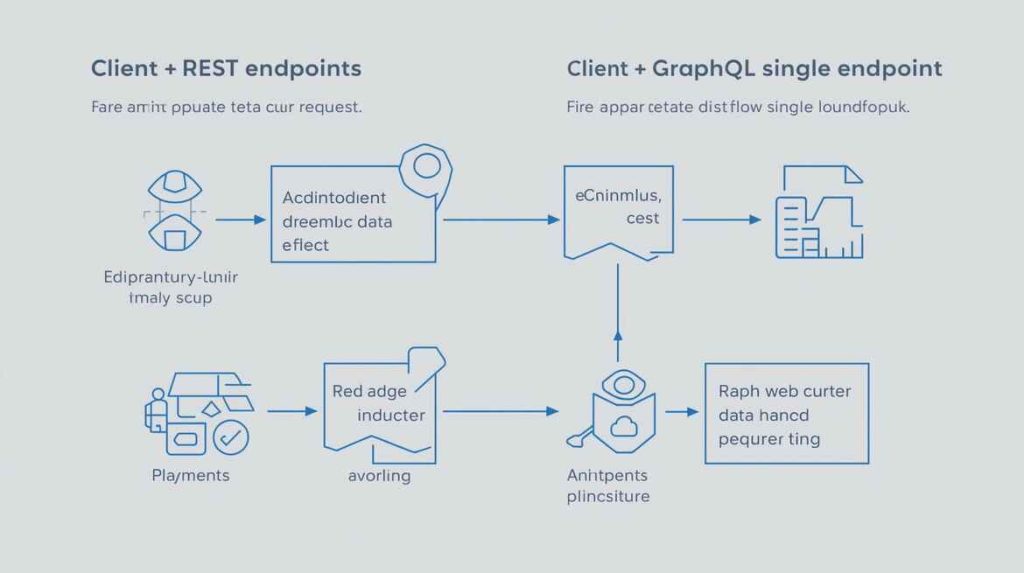
Both REST and GraphQL solve the same problem: moving data between systems. However, they approach it in different ways.
The choice matters because it affects:
- API performance
- Network usage
- Front-end development speed
- Maintenance complexity
- Scalability
Understanding these differences helps teams build faster, cleaner, and more reliable systems.
Data Fetching: Fixed vs Flexible
One of the biggest differences lies in how data is fetched.
REST Data Fetching
REST endpoints return fixed data structures. If the client needs more data, it must call another endpoint. This often leads to:
- Over-fetching (getting extra data you do not need)
- Under-fetching (needing multiple requests for one screen)
GraphQL Data Fetching
GraphQL allows the client to request exactly what it wants in one query. This reduces:
- Unnecessary data transfer
- Extra network requests
- Response size
Because of this, GraphQL often performs better in data-heavy front-end applications.
API Design and Endpoints
REST Design
REST uses many endpoints, such as:
/users/users/1/orders/products
Each endpoint handles one type of resource.
This design is easy to understand and works well for simple systems.
GraphQL Design
GraphQL uses a single endpoint, usually /graphql. All queries go through it.
The schema defines:
- Types
- Fields
- Relationships
This approach centralizes API logic and keeps the structure consistent.
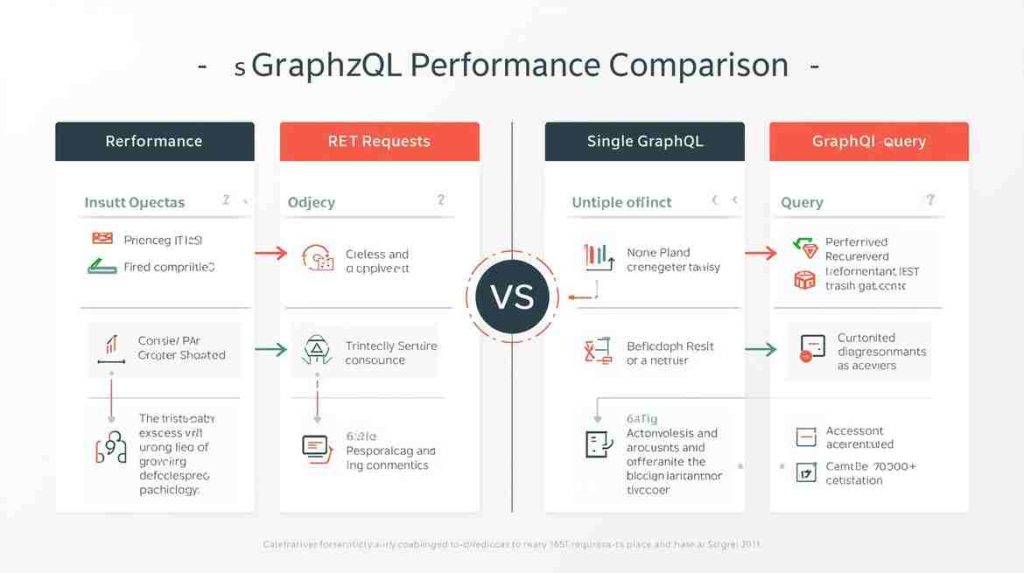
Performance Comparison
Performance depends on the use case, but there are clear patterns.
REST Performance
REST performs well when:
- Data needs are simple
- Caching is important
- Resources rarely change
However, multiple requests can slow down mobile and web apps.
GraphQL Performance
GraphQL performs well when:
- Screens need data from many sources
- Network speed is limited
- Clients need flexible queries
However, complex queries can overload the server if not controlled properly.
In systems that rely on fast data pipelines, such as those described in ETL Process Optimization, efficient API design becomes even more important.
Caching and Network Efficiency
Caching plays a big role in API performance.
REST Caching
REST works naturally with HTTP caching. Browsers and CDNs can easily cache GET requests. This reduces server load and speeds up responses.
GraphQL Caching
GraphQL caching is harder because all requests go through one endpoint. Developers must build custom caching logic or use advanced tools.
As a result, REST still has an advantage in large-scale caching systems.
Error Handling and Debugging
REST Errors
REST uses HTTP status codes:
- 200 for success
- 404 for not found
- 500 for server errors
This system is simple and widely understood.
GraphQL Errors
GraphQL always returns a 200 status code, even when errors happen. Errors appear inside the response body.
While this provides more detail, it can confuse monitoring systems and logging tools.
Versioning and API Evolution
APIs change over time. How they handle versioning matters.
REST Versioning
REST often uses versioned URLs:
/api/v1/users/api/v2/users
This approach works well but increases maintenance.
GraphQL Versioning
GraphQL avoids versioning by:
- Adding new fields
- Deprecating old ones gradually
This allows smoother updates without breaking existing clients.
Learning Curve and Tooling
REST Learning Curve
REST is easy to learn. Almost every developer understands HTTP methods and endpoints. Tooling support is excellent, with built-in browser and testing tools.
GraphQL Learning Curve
GraphQL requires learning:
- Schema design
- Query language
- Resolver logic
Although the learning curve is higher, modern tools like GraphiQL and Apollo make development easier.
Security Considerations
Security remains critical for both styles.
REST Security
REST relies on:
- HTTPS
- API keys
- OAuth tokens
Because REST endpoints are predictable, attackers may try automated scans.
GraphQL Security
GraphQL limits over-fetching, which improves data privacy. However, complex queries can create denial-of-service risks.
Security topics discussed in Wireless Security Techniques also apply to protecting API traffic and authentication layers.
When to Use REST
REST works best when:
- The API is simple
- Caching is important
- Teams want stability
- Public APIs need broad compatibility
Many large platforms still use REST successfully today.
When to Use GraphQL
GraphQL works best when:
- Front-end needs flexible data
- Applications have many screens
- Mobile performance matters
- Data relationships are complex
Modern apps and startups often prefer GraphQL for faster UI development.
REST vs GraphQL: Quick Comparison
| Feature | REST | GraphQL |
|---|---|---|
| Endpoints | Multiple | Single |
| Data fetching | Fixed | Flexible |
| Over-fetching | Common | Rare |
| Caching | Easy | Complex |
| Learning curve | Low | Medium |
| Performance | Good for simple apps | Excellent for complex apps |
Final Thoughts
REST and GraphQL are both powerful API styles. REST offers simplicity, stability, and strong caching support. GraphQL offers flexibility, efficiency, and better control over data fetching.
There is no single best choice for every project. The right option depends on your system size, team skills, and performance needs.
In many cases, teams even use both together. REST handles simple services, while GraphQL powers complex front-end queries.
Choosing wisely helps build faster, cleaner, and more scalable applications.
FAQs
REST uses multiple fixed endpoints with predefined responses, while GraphQL uses a single endpoint and lets clients request exactly the data they need.
GraphQL can be faster when many data sources are involved, because it reduces the number of network requests and avoids sending unnecessary data.
Yes, REST remains widely used because it is simple, stable, well-supported, and works very well with caching and public APIs.
Yes, many systems combine REST for simple services and GraphQL for complex front-end queries to get the best of both approaches.