Cybersecurity Best Practices for Banks in 2026
In 2026, banks face a rapidly evolving threat landscape where cyberattacks are more sophisticated, more frequent, and more costly than ever. As financial institutions, banks store highly sensitive customer data, process millions of transactions daily, and operate critical infrastructure that hackers view as prime targets. Because of this, implementing strong cybersecurity best practices is no longer optional it’s essential for survival.
This article breaks down the most effective cybersecurity strategies for banks in 2026, explains why each practice matters, and gives practical steps IT teams can implement right now.
Why Strong Cybersecurity Matters for Banks
Cybersecurity does more than protect data it protects trust. When a bank’s systems are compromised, customers lose confidence. Regulations get triggered. Financial losses multiply. In extreme cases, institutions can even lose their license to operate.
Strong cybersecurity helps banks:
- Maintain customer trust
- Prevent fraud and financial loss
- Comply with regulations
- Protect critical infrastructure
- Reduce downtime
A good security posture is part defense, part resilience.
1. Zero Trust Architecture: Assume No One Is Trusted
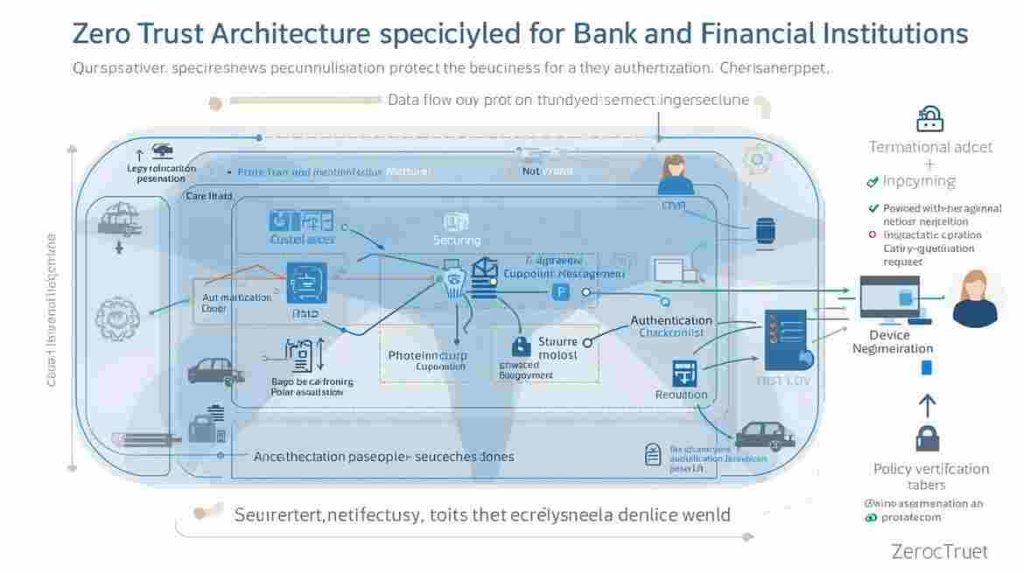
One of the most powerful trends in cybersecurity is Zero Trust Architecture (ZTA). Instead of trusting users or devices inside the network, Zero Trust assumes every request must be verified.
This means:
- Every access attempt is authenticated and authorized
- Least privilege is enforced
- Micro-segmentation limits lateral movement
In a Zero Trust model, even internal traffic is inspected and monitored, limiting the blast radius of breaches.
2. Multifactor Authentication for All Access Points
Password-only security is not enough. Banks should require multifactor authentication (MFA) everywhere for employees, administrators, customers, and even third-party vendors.
Best practices include:
- Using hardware tokens or app-based MFA
- Requiring MFA for all remote access
- Monitoring for suspicious MFA failures
This simple step dramatically reduces the risk of credential theft attacks.
3. Network Segmentation and Least-Privilege Access
Segmenting networks ensures that a breach in one area does not expose the entire system. Banks should divide systems based on function (e.g., payments, loans, customer service, internal admin) and enforce least-privilege access so users and systems only have the access they need to do their job.
This is similar in concept to isolating wireless systems in home networks as discussed in Wireless Security Techniques, where limiting unnecessary access reduces the chance of compromise.
4. Real-Time Threat Detection Using AI/ML
Cyber threats change faster than manual teams can react. That’s why modern cybersecurity uses AI and machine learning to detect patterns of malicious activity in real time. These systems monitor:
- Unusual login attempts
- Anomalous data transfers
- Changes in user behavior
- Known malware signatures
With AI-driven security, banks can respond before damage occurs, rather than after.
5. Secure Software Development Lifecycle (SSDLC)
Banks increasingly depend on custom applications. That makes secure coding essential. A Secure Software Development Lifecycle (SSDLC) embeds security into every stage of software creation:
- Threat modeling during design
- Code reviews and static analysis
- Automated testing
- Continuous monitoring post-deployment
Protecting applications from the start reduces vulnerabilities later.
6. Regular Employee Cybersecurity Training

Human error is one of the largest factors in breaches. Employees must understand how to spot phishing emails, secure their devices, and report suspicious activity.
Training should include:
- Simulated phishing tests
- Mandatory security refreshers
- Clear reporting channels
- Updated policies on remote work
Employees are the first line of defense not just passive system users.
7. Strong Endpoint Protection
With remote work and mobile banking, endpoint devices are everywhere. Each is a potential gateway for attackers.
Banks should use:
- Endpoint Detection and Response (EDR) tools
- Regular patching and updates
- Device encryption
- App whitelisting
Configuration management and patch automation ensure devices stay secure without excessive manual work.
8. Cloud Security Best Practices
Many banks use cloud services for scalability and agility. However, cloud also introduces new security challenges. Best practices include:
- Identity and Access Management (IAM) controls
- Encryption of data at rest and in transit
- Secure APIs with authentication and monitoring
- Logging and auditing of all cloud activity
Understanding how systems interact securely is similar to learning API principles as in REST and REST APIs, which emphasize secure and clear communication between services.
9. Regular Penetration Testing and Red Team Exercises
Penetration testing simulates real attacks so banks can uncover vulnerabilities before attackers do. Red Team exercises go further by combining tools, tactics, and procedures (TTPs) based on real threat actor behavior.
Regular testing:
- Validates defenses
- Educates defenders
- Improves response playbooks
These exercises should be scheduled quarterly or after major system changes.
10. Incident Response Planning and Tabletop Drills
A strong cybersecurity strategy prepares for breaches as well as prevention. An Incident Response (IR) plan outlines who does what when a breach happens.
Key elements include:
- Communication protocols
- Containment strategies
- Forensic analysis procedures
- Recovery timelines
Teams should run tabletop drills that practice responses to ransomware, data breaches, insider threats, and DDoS attacks.
11. Continuous Compliance Monitoring
Banks face strict regulatory requirements related to privacy and security. Staying compliant means integrating compliance checks into everyday operations, not just annual audits.
Essential areas include:
- PCI DSS
- GLBA
- FFIEC guidelines
- Local and international data protection laws
Automated compliance tools help reduce gaps and manual errors.
12. Supply Chain and Third-Party Risk Management
Banks rely on partners for services like payments, data storage, and software tools. Each third party introduces risk. Therefore:
- Evaluate vendor security posture
- Require security standards in contracts
- Monitor vendor access continuously
- Revoke privileges when no longer needed
Third-party risk must be part of the bank’s overall security strategy.
13. Protecting Customer Data With Encryption
Strong encryption protects customer data, whether it is stored (data at rest) or moving across networks (data in transit). Banks should:
- Use up-to-date encryption standards
- Rotate encryption keys regularly
- Manage certificates securely
Encryption is fundamental to maintaining confidentiality and trust.
14. Cyber Insurance Coverage
Even with strong controls, no bank is immune. Cyber insurance can provide financial protection for:
- Incident response costs
- Legal fees
- Customer notification
- Business interruption
Policies should be aligned with the bank’s risk profile and updated regularly.
Final Thoughts
In 2026, cybersecurity for banks is not just about firewalls or antivirus. It is about adaptive, proactive, and holistic security that covers people, processes, and technology. The best practices listed here go beyond compliance they focus on resilience, detection, and rapid response.
Banks that embed cybersecurity into every layer of their operations will be better prepared for evolving threats and will maintain customer trust and regulatory compliance.
FAQs
Zero Trust means every access request is verified and authorized, even from within the network, to reduce breach impact and lateral movement.
MFA adds extra verification beyond passwords, making it much harder for attackers to gain unauthorized access.
Penetration testing simulates real cyberattacks to uncover vulnerabilities before attackers do and improve defenses.
Employee security training should be updated at least quarterly or whenever new threats and tools emerge.