
Business Process Automation Services: A Complete Guide for 2026
Business process automation (BPA) services help organizations automate repetitive tasks and workflows using technology. These services reduce manual work, improve efficiency, and allow businesses to focus on strategic activities.
In simple terms, business process automation replaces time-consuming manual processes with automated systems that run faster, more accurately, and with fewer errors.
In 2026, BPA has become a key part of digital transformation, helping companies streamline operations, reduce costs, and improve productivity across departments.
What Are Business Process Automation Services?
Business process automation services involve designing, implementing, and managing automated workflows within an organization. These workflows use software, integrations, and sometimes AI to handle routine tasks.
Common automated processes include:
- Invoice processing
- Employee onboarding
- Customer data management
- Email and marketing workflows
- Approval and reporting systems
Many companies combine BPA with workflow automation tools to connect multiple applications and eliminate manual data entry.
The goal is simple: make operations faster, more reliable, and scalable.
Why Businesses Are Investing in BPA
Organizations today deal with large volumes of data and repetitive administrative work. Manual processes slow down operations and increase the risk of errors.
Business process automation helps by:
- Reducing operational costs
- Increasing process speed
- Improving accuracy and consistency
- Enhancing employee productivity
- Providing real-time visibility into operations
These advantages align with major business trends where efficiency and automation are critical for growth.
How Business Process Automation Works
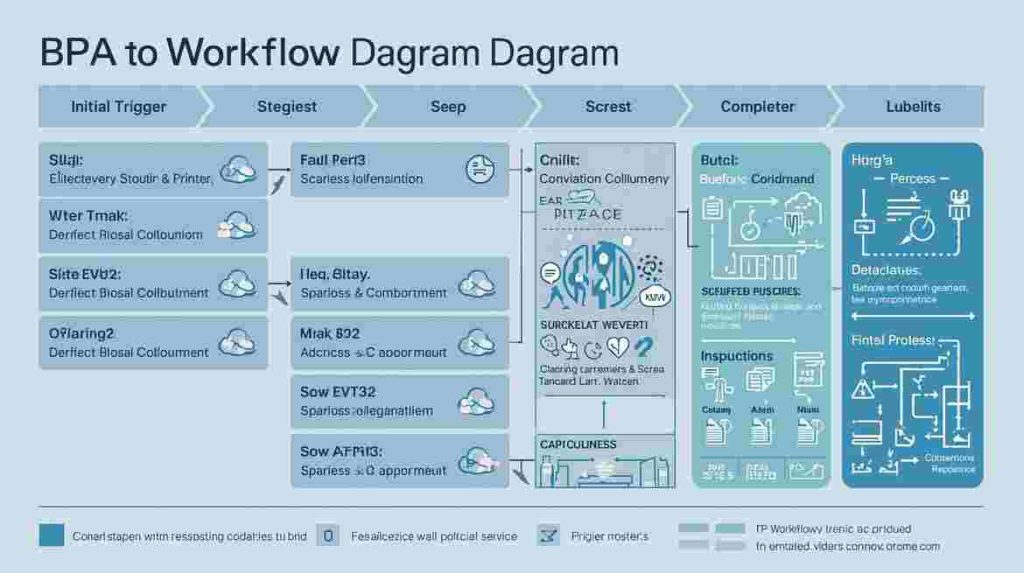
A typical BPA implementation follows several steps:
1. Process Identification
Companies identify repetitive, rule-based tasks suitable for automation.
2. Workflow Design
Automation experts map the process and define triggers, actions, and decision points.
3. Tool Integration
Systems such as CRM, accounting, HR, and cloud platforms are connected.
4. Automation Deployment
The automated workflow is tested and launched.
5. Monitoring and Optimization
Performance is tracked and improvements are made over time.
Many organizations now run automated workflows in cloud environments to ensure scalability and remote access.
Key Types of Business Process Automation
1. Robotic Process Automation (RPA)
Uses software bots to perform repetitive tasks like data entry, form processing, and report generation.
2. Workflow Automation
Automates task sequences such as approvals, notifications, and document routing.
3. Intelligent Automation
Combines automation with AI for tasks like document recognition, data analysis, and decision-making.
4. Integration Automation
Connects different applications so data flows automatically between systems.
Businesses adopting intelligent automation are part of the broader shift toward modern technology solutions that improve operational efficiency.
Common Use Cases Across Departments
Finance
- Invoice and expense processing
- Financial reporting
- Budget tracking
Human Resources
- Employee onboarding
- Payroll processing
- Leave management
Sales and Marketing
- Lead management
- Email campaigns
- Customer follow-ups
Customer Support
- Ticket routing
- Automated responses
- Service tracking
These use cases show how BPA improves both internal operations and customer experience.
Benefits of Business Process Automation Services
Increased Efficiency
Automated processes run faster than manual workflows and operate 24/7.
Cost Reduction
Automation reduces labor costs and minimizes errors that lead to financial losses.
Improved Accuracy
Standardized workflows eliminate inconsistencies and manual mistakes.
Better Compliance
Automation ensures processes follow predefined rules and regulatory requirements.
Scalability
Businesses can handle higher workloads without increasing staff.
Organizations using automation alongside data analytics strategies gain deeper insights into performance and decision-making.
Business Process Automation vs Digital Transformation
Business process automation is often part of a larger digital transformation strategy.
| BPA | Digital Transformation |
|---|---|
| Focuses on specific workflows | Covers entire business systems |
| Automates repetitive tasks | Modernizes technology and operations |
| Improves efficiency | Improves overall business model |
BPA is usually the first step companies take when modernizing operations.
Challenges of BPA Implementation
Despite its advantages, automation requires proper planning.
Common Challenges
- High initial setup cost
- Integration complexity
- Resistance to change from employees
- Poor process selection
- Lack of technical expertise
Working with experienced automation providers helps businesses avoid these issues and achieve better results.
How to Choose the Right BPA Service Provider
When selecting a business process automation service, consider:
- Industry experience
- Integration capabilities
- Security and compliance standards
- Scalability options
- Support and maintenance services
Companies handling sensitive data should ensure providers follow strong security practices to protect business information.
The Role of AI in Business Process Automation

Artificial intelligence is transforming BPA in 2026.
AI-powered automation can:
- Extract data from documents
- Predict workflow outcomes
- Detect anomalies and errors
- Provide intelligent decision support
This shift toward intelligent automation is part of broader AI adoption trends across industries.
As AI becomes more accessible, BPA services are moving beyond simple task automation to smarter, adaptive workflows.
Future of Business Process Automation
The BPA market continues to grow as organizations seek efficiency and agility.
Key trends include:
- Low-code and no-code automation platforms
- Cloud-native workflow systems
- AI-driven process optimization
- Real-time performance monitoring
- End-to-end business automation
Companies that invest in automation today will be better prepared for increasing competition and operational complexity.
FAQs
They help organizations automate repetitive tasks and workflows using software to improve efficiency and reduce manual work.
Repetitive, rule-based, and high-volume tasks such as data entry, approvals, and reporting are ideal for automation.
Yes, automation helps small businesses save time, reduce costs, and scale operations more efficiently.
RPA focuses on task automation using bots, while BPA covers entire workflows and process optimization.
Many modern platforms offer low-code or no-code options, making automation accessible without advanced programming skills.