
Emerging Technologies in Finance and Accounting
Finance and accounting are no longer limited to spreadsheets and manual audits. Instead, modern systems rely heavily on intelligent automation, real-time analytics, and decentralized technologies. Because financial environments demand accuracy, speed, and compliance, emerging technologies now play a central role in reshaping how organizations manage money.
In 2026, the financial industry is experiencing a structural transformation. Rather than simply digitizing paperwork, companies are redesigning entire workflows using artificial intelligence, blockchain systems, cloud platforms, and automation tools. As a result, finance professionals are shifting from repetitive tasks to strategic decision-making.
This guide explains the most important emerging technologies in finance and accounting, how they work, and why they matter.
1. Artificial Intelligence and Machine Learning
Artificial intelligence (AI) has moved beyond experimentation and into daily operations. Today, AI systems analyze financial data, detect fraud patterns, forecast revenue, and automate reporting.
For example, AI-powered tools can:
- Identify unusual transactions instantly
- Predict cash flow shortages
- Recommend cost-saving opportunities
- Generate financial summaries automatically
Because machine learning improves over time, predictions become more accurate with larger datasets. Additionally, AI reduces human error in reconciliation and auditing processes.
AI in finance also connects closely with broader infrastructure developments discussed in what is AI in cloud computing, where large-scale data processing supports intelligent decision-making.
2. Robotic Process Automation (RPA)
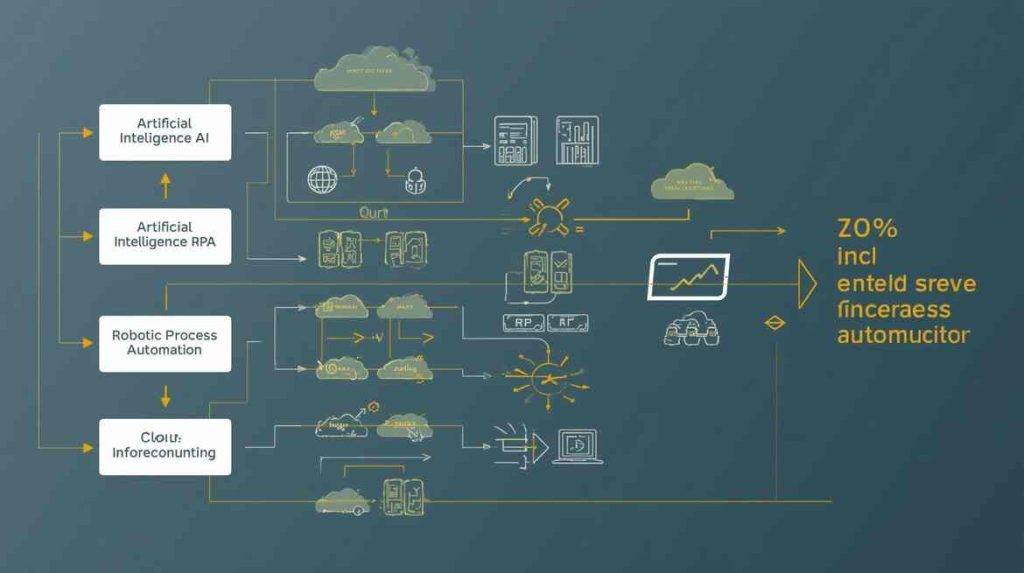
Robotic Process Automation uses software “bots” to handle repetitive accounting tasks. These bots perform actions such as data entry, invoice matching, payroll processing, and compliance checks.
Unlike AI, which analyzes patterns, RPA follows rule-based workflows. However, when combined with AI, RPA becomes significantly more powerful.
Key benefits include:
- Reduced operational costs
- Faster processing times
- Fewer manual errors
- Improved compliance accuracy
Because accounting involves structured data, RPA adoption continues to grow rapidly.
3. Blockchain and Distributed Ledger Technology

Blockchain technology introduces transparency and tamper-resistant records. Instead of storing financial data in one central database, blockchain distributes records across a network.
This structure provides:
- Enhanced audit trails
- Reduced fraud risk
- Faster cross-border payments
- Improved trust between parties
In accounting, blockchain simplifies verification processes. Auditors can track transactions in real time without relying solely on internal documentation.
Moreover, digital assets such as USD Coin (USDC) demonstrate how blockchain enables stable and transparent financial transactions.
4. Cloud-Based Financial Systems
Cloud computing has become the backbone of modern finance. Instead of relying on local servers, organizations now use cloud-based accounting platforms.
Cloud systems provide:
- Real-time collaboration
- Automatic updates
- Remote access
- Scalable storage
Because data remains centralized and synchronized, financial teams can work from anywhere while maintaining accuracy. Cloud platforms also support integration with AI and analytics tools.
5. Big Data and Advanced Analytics
Data analytics has transformed financial planning. Companies now use advanced analytics tools to interpret massive datasets and extract meaningful insights.
With real-time dashboards, organizations can:
- Monitor performance metrics
- Analyze spending trends
- Detect financial anomalies
- Forecast long-term growth
As businesses adopt predictive analytics, finance shifts from reactive reporting to proactive strategy.
For digital businesses, understanding performance indicators such as revenue efficiency like Page RPM in Google AdSense demonstrates how analytics drives smarter financial decisions.
6. Embedded Finance
Embedded finance integrates financial services directly into non-financial platforms. For example, e-commerce platforms now offer instant credit, insurance, and payment processing within their systems.
This model removes friction and simplifies transactions. Instead of visiting a bank, users access financial services directly within apps they already use.
As embedded finance expands, traditional banking boundaries continue to blur.
7. Cybersecurity and Fraud Detection Technologies
As finance becomes more digital, cybersecurity becomes more critical. Advanced encryption, biometric authentication, and AI-based monitoring protect financial systems.
AI-driven fraud detection systems analyze patterns in milliseconds. When suspicious activity appears, alerts trigger immediately.
Because financial data remains highly sensitive, emerging security technologies are essential for maintaining trust.
8. Digital Payments and Central Bank Digital Currencies (CBDCs)
Digital payment technologies have expanded beyond credit cards and online banking. Contactless payments, mobile wallets, and digital currencies are becoming standard.
Additionally, several governments are exploring Central Bank Digital Currencies (CBDCs). These digital versions of national currencies aim to improve transaction efficiency and financial inclusion.
As payment systems evolve, financial institutions must adapt quickly.
9. Green Finance and Sustainability Tech
Emerging technology also supports sustainability in finance. Environmental, Social, and Governance (ESG) reporting tools track carbon footprints and ethical investments.
Because investors increasingly demand transparency, financial software now includes ESG analytics dashboards.
This shift ensures that profitability aligns with responsible practices.
10. AI-Powered Auditing
Auditing is becoming faster and more precise through AI-driven tools. Instead of manually reviewing thousands of records, auditors use intelligent systems to scan full datasets instantly.
These tools:
- Flag inconsistencies
- Identify risk patterns
- Generate automated reports
As a result, auditing becomes more comprehensive and less time-consuming.
How These Technologies Work Together
Emerging technologies in finance do not operate independently. Instead, they integrate into unified ecosystems.
For example:
- Cloud platforms host accounting systems
- AI analyzes financial data
- RPA automates workflows
- Blockchain verifies transactions
- Analytics tools visualize performance
This interconnected model improves efficiency, transparency, and decision-making.
Future Outlook: 2026 and Beyond
Finance and accounting will continue shifting toward automation and intelligence. Professionals will focus more on strategy and advisory roles rather than manual data processing.
Moreover, companies that adopt these technologies early gain competitive advantages through speed, accuracy, and insight.
The future of finance will be:
- Data-driven
- Automated
- Secure
- Accessible
Those who adapt will thrive.
FAQs
Artificial intelligence currently leads because it enhances fraud detection, forecasting, automation, and financial analytics.
Blockchain improves transparency and creates tamper-resistant records, simplifying auditing and verification processes.
Cloud systems allow real-time collaboration, scalability, and integration with AI and analytics tools.
Automation reduces repetitive tasks, but accountants will shift toward strategic advisory and decision-making roles.